
The Autenti Qualified Validator is available directly through the Autenti platform or via API integration. Using it does not require any additional devices.
Step-by-Step Verification Instructions
The process of verifying and downloading results consists of three simple steps:
- Upload the file: Log in to the Autenti platform, select Qualified Validator from the menu, and upload your document (a PDF file signed via Autenti or another document containing a signature/seal).
- Run validation: Click the Validate button. The system will immediately verify the authenticity and integrity of the signatures and seals.
- Download the result: Download the generated documents: Validation Proof (PDF) and Validation Report (XML).
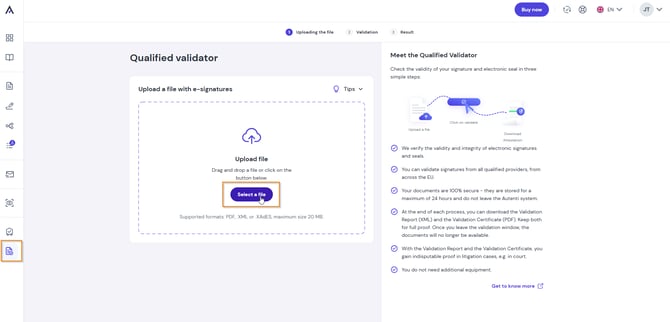
Important: Save both files (PDF and XML) to your local drive as complete evidentiary material. Once you leave the validation window, these documents will no longer be accessible in the system.
What Do You Gain with the Autenti Qualified Validator? (Key Benefits)
- Formal confirmation of validity: Receive an eIDAS-compliant validation proof for your e-signature or e-seal.
- Unique technology: The only solution on the market that provides full validation for standard and advanced Autenti e-signatures.
- Versatility: Verifies qualified signatures, as well as Trusted Signatures (Profil Zaufany) and Personal Signatures (e-ID card certificates).
- Data transparency: Receive a clear set of information (personal details, technical validity of the certificate, provider name, signature type, and timestamp presence).
- Process automation: API integration allows fast and reliable validation of large volumes of documents at once.
- Data security: Data processing is based on infrastructure located within the European Economic Area.
Business Applications and Risk Protection
- Public procurement: Reduce the risk of your tender offer being rejected on formal grounds.
- Regulated sectors (leasing, insurance, finance): Strengthen the evidentiary value of high-value contract portfolios.
- Legal disputes and audits: Gain indisputable legal evidence in the event of court cases or official inspections.
Why is the Verifier in Popular PDF Readers Not Enough?
The verifier in free PDF readers offers only a technical preview. It scans the hidden electronic layer of a file to check its status. However, it is not an official trust service - it does not provide formal proof for business use, does not benefit from legal presumptions, and the software developer bears no liability for errors. Such a preview is sufficient only for low-risk, internal matters.
Full security is provided only by the Autenti Qualified Validator. It is a formalized, eIDAS-compliant trust service where the provider assumes full liability for the verification result, which shifts the burden of proof in court. The tool generates a cryptographically sealed report that "freezes" the status of the signature at a given date and time. As a result, the document remains ironclad evidence even years later when certificates expire.
This level of validation is essential for public tenders, regulated entities, and key contracts. Furthermore, the Autenti Qualified Validator is the only tool on the market that natively recognizes and verifies standard and advanced Autenti e-signatures while presenting complete signer details.
When is Standard Verification Enough, and When Do You Need Qualified Validation?
It depends on the level of risk. Standard verification is sufficient for low-stakes, internal matters. You need qualified validation whenever large amounts of money, legal matters, audits, or foreign partners are involved.
Standard verification is enough when:
- Handling internal matters: Documents without legal consequences (leave requests, clearance slips, internal policies).
- Running a technical test: Checking whether a file was corrupted during email download.
- Risk is minimal: Low-stakes documents where a dispute with a counterparty is unlikely.
Qualified validation is essential when:
- Bidding in public tenders: Required by regulations and legal rulings - a free reader tool may incorrectly reject an offer.
- Verifying foreign signatures: Standard programs lack the EU Trusted List database and display false errors for certificates from other EU countries.
- Preparing executive contracts: Handing documents with defective counterpart signatures to board members poses a major legal risk to the company.
- Collecting evidence for court: A qualified report cuts off attempts to challenge a contract (e.g., in cases of fraud or extortion).
- Operating in a regulated sector: Banks, insurance companies, and leasing entities must meet strict regulatory and AML requirements.